
How and What to Measure from Day One when Building a Startup
One of the biggest challenges at the initial stages is to keep the whole team focused on one common goal. Showing promising results of…
One of the biggest challenges at the initial stages is to keep the whole team focused on one common goal. Showing promising results of their effort can be very motivational. But how to conduct research that shows it?
Software developers tend to focus only on the technology, designers on the interface and UX, and Scrum Masters on the process of building the software. As a result, it often happens that everyone is concerned only with his own goal, and the team isn’t capable of working together for the bigger picture, which additionally may not be clear enough.
How To Organize The Team?
A good solution to the issues above is measuring results, and organizing work towards the common goal. It has to be expressed in numbers (quantified), as a well-defined indicator, available for the whole team. An exemplary scheme of team’s organization looks like:
→ Every week starts with planning — we determine what we can do to improve the indicator, and ends with a summary and evaluation of the indicator’s change, as a result of the team’s work last week.
→ In this way, every week is treated as one or several experiments, which check whether we are getting closer to our goal.
→ What these experiments can consist of? They may be new functionalities (or prototypes of new functionalities), landing page changes for better conversion, changes in ad campaigns, or new content on the website. No holds barred, just focus on getting closer to the goal.
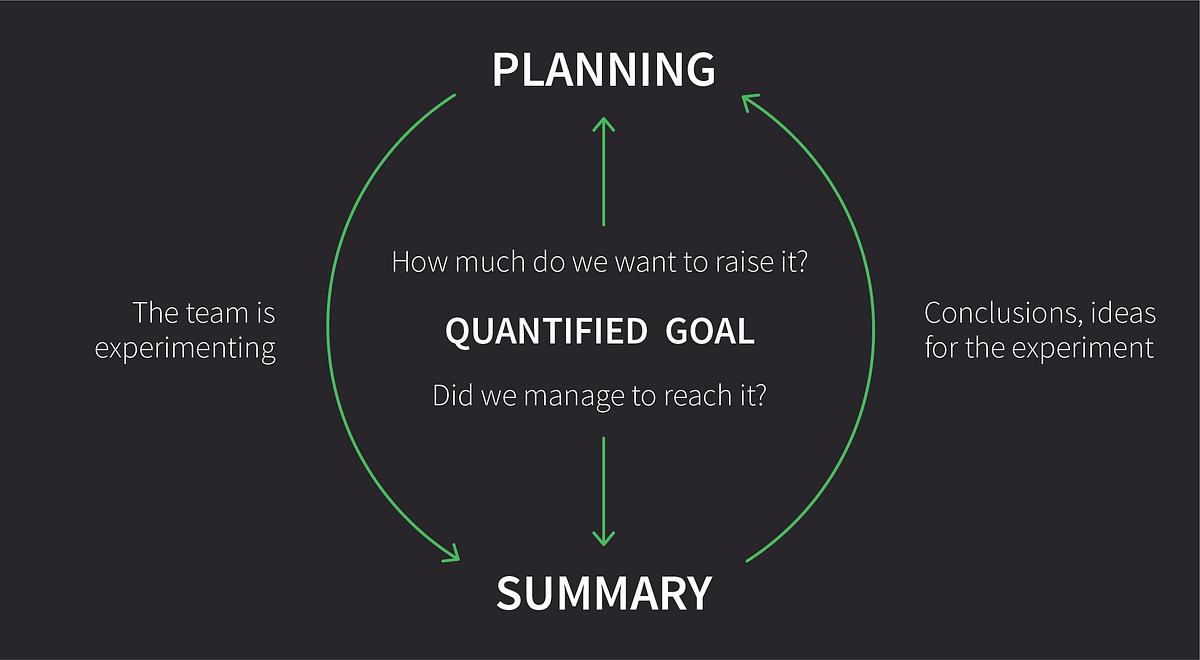 Organization of work in a startup
The Question Remains — What and How to Measure?
The answer to this question can be the Lean Analytics model, which is an extension of Lean Startup methodology. It was created and described by Alistair Croll and Benjamin Yoskovitz in their book “Lean Analytics”. This is a great source of inspirations for organizing a startup team.
The first important thing to realize is that startup at an early stage of development is rather limited in resources. Therefore, the whole team should optimize only one metric. Someone may ask — only one?! The answer is: yes, only one! The second question to face is: what to measure? And it depends mainly on two factors — what kind of product we create (its category) and — at what stage are we.
Engagement and Churn
How to measure Engagement? For example, by analyzing the percentage of users who subscribe to your newsletter and then come back to use the product in the next week/month.
ENGAGEMENT = U returning / U total
Where U total is the number of new users in a given period of time, and U returning is the number of users in a given period of time, who returned within the next week/month.
How to measure the second indicator i.e. Churn? By checking what percentage of users who resign/unsubscribe from our product (e.g. resigned from the paid subscription).
CHURN = U canceled / U all
U canceled — the number of users, who canceled their subscription in a given month.
U all — the number of all users, who have a subscription in a given month.
CAC and CLV
On the further stages we can measure CAC — Customer Acquisition Cost and CLV — Customer Lifetime Value. These two indicators will define the profitability of our business. It can be assumed we have a promising business model if:
CLV > 3 x CAC
To better understand how our product is developing, in the further stages of company’s operation we should measure many indicators, and each team should have several metrics. However, we have to make sure that Data Driven Development won’t turn into KPI Driven Development, which is well-known in the corporate world.
Welcome to the Post-Agile Era
The aim of a startup team is to deliver results, not functionalities, design, or other elements. We have to consider the fact that the very popular lately Scrum is focused on handing over working software, and may not be the best choice for a startup. As the management methods in startups often move later to “mainstream”, we can slowly start talking about the beginning of the new era in building software: Post-agile, or Lean-Startup era, in which Data Driven Development is a standard, and building “just working software” isn’t good enough anymore.

If you enjoyed this post, please don’t forget to tap ❤! You can also follow us on Facebook, Twitter and LinkedIn.
Comments
Loading comments…